







For decades, banks have operated one of the most profitable business models in finance.
They collect deposits, pay customers very little interest, lend that money out at much higher rates, and layer fees across nearly every service. Monthly maintenance fees, overdraft charges, ATM costs, wire fees, paper statement fees, inactivity penalties, the list goes on. Meanwhile, banks continue to earn from the spread between what they pay depositors and what they earn on loans and investments.
That model worked for a long time because most people had no real alternative.
Now they do.
Stablecoins offer something different: faster settlement, lower transfer costs, 24/7 availability, borderless access, programmability, and, in some cases better yield opportunities through crypto platforms and decentralized finance.
That is why the current policy debate matters. It is not just about digital assets. It is about who controls the next evolution of money.
Why Stablecoins Look More Attractive Than Fiat in the Banking System

The advantage of stablecoins becomes clear when compared to traditional payment rails.
Bank transfers still operate on banking hours. ACH payments can take one to three business days. Wire transfers can be expensive. Cross-border payments are often even slower and more costly.
Stablecoins, by contrast, can move within seconds or minutes, around the clock, often for a fraction of the cost.
But speed is only part of the story.
Stablecoins are also programmable. They can connect directly to smart contracts, payment systems, trading platforms, lending protocols, and corporate treasury operations in ways that traditional fiat accounts cannot. In that sense, they are not just digitized dollars, they are internet-native dollars designed to function inside digital financial infrastructure.
Then there is the issue of yield.
Most traditional deposit accounts still pay extremely low interest compared to what users can potentially access through crypto-based financial rails. This shift matters because banks rely heavily on cheap deposits. If customers can hold dollar-backed assets outside the banking system and still earn better returns, the traditional model begins to weaken.
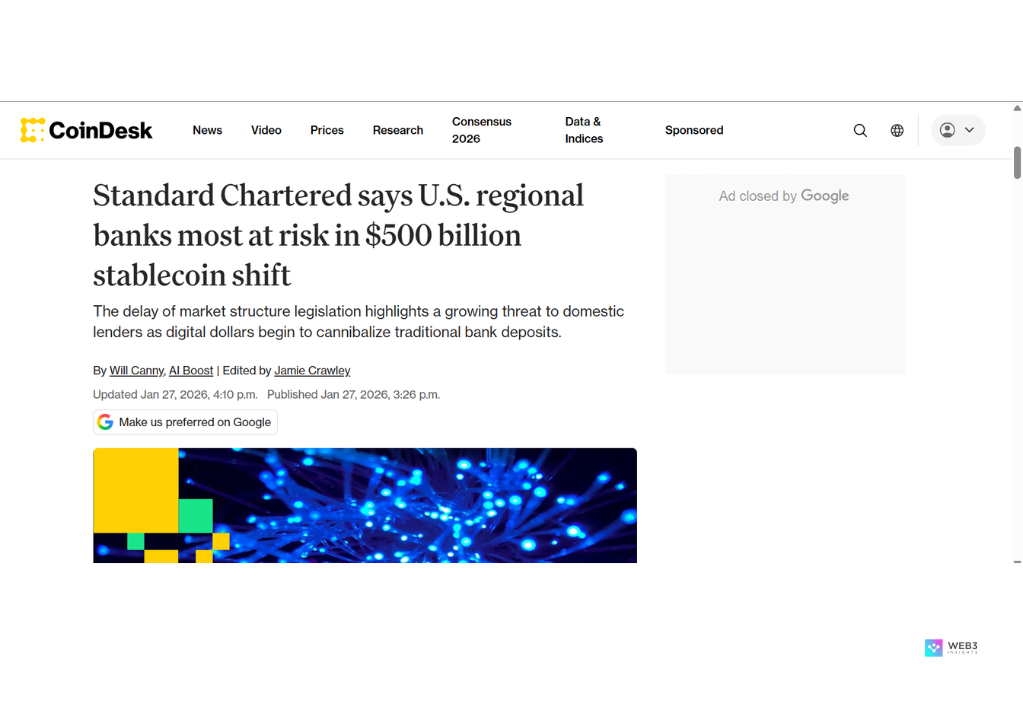
Some analysts already see this as a serious risk for banks. A report suggested U.S. banks could lose hundreds of billions of dollars in deposits over the coming years if stablecoin adoption accelerates.
That would not be a minor shift. It would directly affect how banks fund lending and credit.
What the GENIUS Act Does, and Where CLARITY Enters the Debate
The first major law in this story is the GENIUS Act, short for the Guiding and Establishing National Innovation for U.S. Stablecoins Act. It introduced the first federal framework for payment stablecoins in the United States.
The law requires stablecoins to be fully backed by liquid reserves such as U.S. dollars or short-term Treasury assets. It also requires regular reserve disclosures and stronger oversight designed to protect consumers.
This structure is fundamentally different from traditional banking.
Banks operate on fractional reserves, meaning deposits can be lent out and reused throughout the credit system. Under the GENIUS framework, stablecoins are supposed to remain fully backed one-to-one.
In simple terms, the issuer must hold the money rather than relending it.
That difference is one reason the banking industry has raised concerns. A transparent, fully reserved digital dollar begins to look very different from a typical bank deposit.
However, the GENIUS Act also introduced another key rule: stablecoin issuers themselves are not allowed to pay interest on stablecoins.
Banks supported that restriction. But they argued the law still left a potential loophole. Third-party platforms such as exchanges or affiliated services could potentially offer rewards or yield linked to stablecoins, creating competition for bank deposits.
That is where the discussion around the CLARITY Act enters the picture.
So, Are Banks Opposing the Stablecoins ACT?

The short answer is yes, but not in a simple way.
Banks are not universally against stablecoins. In fact, several large financial institutions have explored launching their own versions. Reports have linked banks such as JPMorgan, Bank of America, Citigroup, and Wells Fargo to stablecoin research and potential development.
The real concern is not the existence of stablecoins.
The concern is whether stablecoins could become better cash products than traditional bank accounts.
Banking lobbyists have argued that if stablecoin platforms are allowed to offer yield or rewards, deposits could flow away from community banks and regional lenders. That shift could weaken the funding base that banks rely on for lending.
Public statements from major bank leaders reflect this view. JPMorgan CEO Jamie Dimon has warned against creating what he describes as a “parallel banking system,” while Bank of America CEO Brian Moynihan has suggested that yield-bearing stablecoins could pull large amounts of money out of bank deposits.
Industry groups such as the American Bankers Association have also raised concerns that yield-offering stablecoin platforms could gain a regulatory advantage over traditional banks.
From the banking sector’s perspective, this risk is real. If users can hold dollar-like assets that move faster, cost less to transfer, remain transparently backed, and still earn higher returns, many customers may choose those alternatives over traditional deposit accounts.
The Argument Banks Are Making

Banks frame the issue primarily as a matter of financial stability.
They argue that if deposits move out of the banking system and into higher-yielding stablecoins, banks could lose an important source of low-cost funding. That could reduce their ability to obtain mortgages, small-business loans, and other forms of credit.
Regulators in several regions have acknowledged that large-scale adoption of stablecoins could affect how deposits flow through the financial system.
However, many voices in the crypto industry see the situation differently.
To them, stablecoins are simply revealing weaknesses in the traditional banking model. If customers prefer faster, cheaper, and more transparent financial tools, the argument goes, the problem may not be the technology; it may be the existing system.
Some crypto leaders have strongly rejected warnings about destabilization. Circle CEO Jeremy Allaire, for example, has argued that fears of stablecoin-driven bank runs are exaggerated and comparable to earlier debates about money market funds.
What This Debate Is Really About

When the policy language and political arguments are stripped away, the core issue becomes clear.
Banks are comfortable with financial innovation as long as it does not threaten their control over deposits.
A fully backed stablecoin is already disruptive. A fully backed stablecoin that can also be integrated into digital financial services, rewards systems, or yield-generating platforms is far more disruptive.
That possibility is what the current policy fight revolves around.
Stablecoins are forcing a direct comparison between two models: the traditional banking system built on legacy infrastructure, and a digital system designed for faster, more flexible financial activity.
For many users, especially younger and globally connected users, that comparison is becoming increasingly obvious.
Conclusion
So are banks opposing the Stablecoins CLARITY Act?
The more precise answer is that banks are opposing parts of the framework that could allow stablecoins to compete directly with bank deposits.
They are not rejecting stablecoins entirely. Many financial institutions are exploring ways to participate in the market themselves. What they are resisting is a scenario where stablecoins evolve into superior cash products operating outside the traditional banking system.
That is why the debate around yield, regulatory loopholes, and stablecoin frameworks has become so intense.
Stablecoins are no longer just another crypto asset. They represent a potential redesign of how digital dollars move, settle, and operate across the global economy.
And banks clearly understand what is at stake.